

The secret to modern trip planning is simple: stop letting your inspiration die in a messy folder of screenshots. It's all about creating a smooth path from the moment you save a TikTok of a hidden Parisian café to actually booking the flight.
From Social Media Daydreams to Real-World Adventures
Let's be honest, your phone is overflowing with saved TikToks, Instagram spots, and random screenshots of places you swear you'll visit someday. If this sounds familiar, you're not alone. This digital clutter is the starting point for countless travel dreams, but it’s also where most of them end up—buried and forgotten.
That initial spark of inspiration is exciting, but it quickly hits a wall. You end up with:
- Decision Paralysis: With dozens of saved pins and links, choosing where to even begin feels impossible.
- Digital Chaos: Your brilliant ideas are scattered across five different apps, making it a nightmare to see the big picture.
- Lost Momentum: The thrill fades the second you realize you have to manually copy-paste every location into a spreadsheet. It starts to feel more like a chore than an adventure.
The Modern Travel Dilemma
The desire to explore is stronger than ever. A whopping 92% of Americans are planning trips for 2025, with 56% aiming to travel more than they did last year.
But there’s a catch. While 58% of travelers want to journey more, they feel held back by skyrocketing costs. In fact, 22% have already canceled trips over finances. This problem gets even worse for social media-savvy travelers who collect endless ideas without a system, turning inspiration into pure frustration.
The core problem isn't a lack of inspiration; it's the absence of a bridge between that inspiration and a realistic, organized plan. The answer isn't another spreadsheet; it's a smarter workflow.
An AI-assisted approach changes the game. Imagine capturing every idea as it strikes and watching it instantly land on a visual map, neatly grouped by city. This is how you go from a chaotic mess of links to an actual itinerary that respects both your time and your budget.
Using social media aggregator tools can help streamline this collection process, but the real magic is turning those daydreams into a plan that gets you out the door. This method makes travel planning feel exciting again, not overwhelming.
Capture and Map Your Inspiration Instantly
Every great adventure starts with a spark of inspiration. A TikTok video of a hidden bookstore in Lisbon, an Instagram Reel of the perfect pizza in Naples. But too often, that spark dies in the "screenshot graveyard" on our phones.
This is where passive scrolling becomes active planning. Let's stop collecting digital clutter and start building a living, breathing map of your travel dreams. The best way to plan a trip is to give all that inspiration a home from the very beginning.
Imagine you see that Lisbon bookstore video. Instead of a screenshot you’ll never find again, you send it directly to your personal travel map. In one tap, the location is extracted and pinned. That's it. This is the simple, powerful first step to modern travel planning.
From Digital Mess to a Curated Map
The goal here is to remove friction. The second you have to manually search for a location, copy an address, and paste it into another app, you've lost momentum. This new approach collapses a 5-minute task into a 5-second action.
Here’s how it completely changes your process:
- Instant Organization: Every spot you save from TikTok, Instagram, or a blog post is automatically sorted by city on your master map. No more messy notes or spreadsheets.
- Visual Clarity: Forget a chaotic list of names. Now you see all your potential destinations laid out geographically, making it incredibly easy to spot clusters of cool places.
- Zero Manual Entry: Your map becomes the single source of truth for every idea. It's a visual library of your interests, built effortlessly as you browse.
This workflow takes you from scattered social media saves to a clear, curated plan that actually leads to your next adventure.
This is how you bridge the gap between seeing something cool online and making it a real part of your travel plans.
Putting It Into Practice: A Weekend Example
Let's say you're thinking about a weekend trip to Sarajevo. You spend 20 minutes browsing and save 15 different spots—from the historic Baščaršija market to a tiny shop recommended for the best traditional ćevapi.
Once you're done, they all appear as pins on your Sarajevo map. Instantly, you see that five of your saved spots are crammed into a tiny, walkable section of the Old Town. This immediately helps you visualize what a day of exploring could look like, without any extra work. If you want a deeper dive, there's a great guide on how to save places directly from TikTok and Instagram to build your map.
This method isn’t just about collecting pins; it's about building a foundation. You are creating a visual database of your personal interests, which makes the next step—building an itinerary—intuitive and fun.
By curating your map, you get insights that spreadsheets just can't offer. You might notice you’ve saved ten coffee shops but no museums, which tells you to diversify your search. Or you might see that a must-visit restaurant is way out of the city center, helping you decide if it's worth the special trip.
For instance, a hearty Balkan meal of grilled meats and šopska salata is a non-negotiable for me, and meals like that rarely cost more than $15-20 per person. Seeing it on the map helps me slot it into the day and the budget perfectly.
This whole approach ends the frustrating cycle of lost links and forgotten screenshots. It creates a unified, visual starting point that makes planning your dream trip feel less like a chore and more like the adventure has already begun.
Building Your Perfect Day-by-Day Itinerary
Alright, you've got your travel ideas beautifully organized on a map. Now for the fun part: connecting the dots and turning that collection of pins into a smart, logical, and genuinely enjoyable schedule. This is where a wish list becomes an actual, actionable plan.
The goal here isn't to create a rigid, minute-by-minute spreadsheet that sucks the life out of your trip. It's about building a flexible framework that makes every day feel effortless and exciting. The best way to do this is to group nearby attractions to maximize your time exploring and minimize time spent on a bus, train, or in a taxi.
Your map isn't just a collection of spots; it’s a blueprint for your adventure. As you look at the pins, you'll start to see natural daily routes emerge.
From Pins on a Map to a Daily Flow
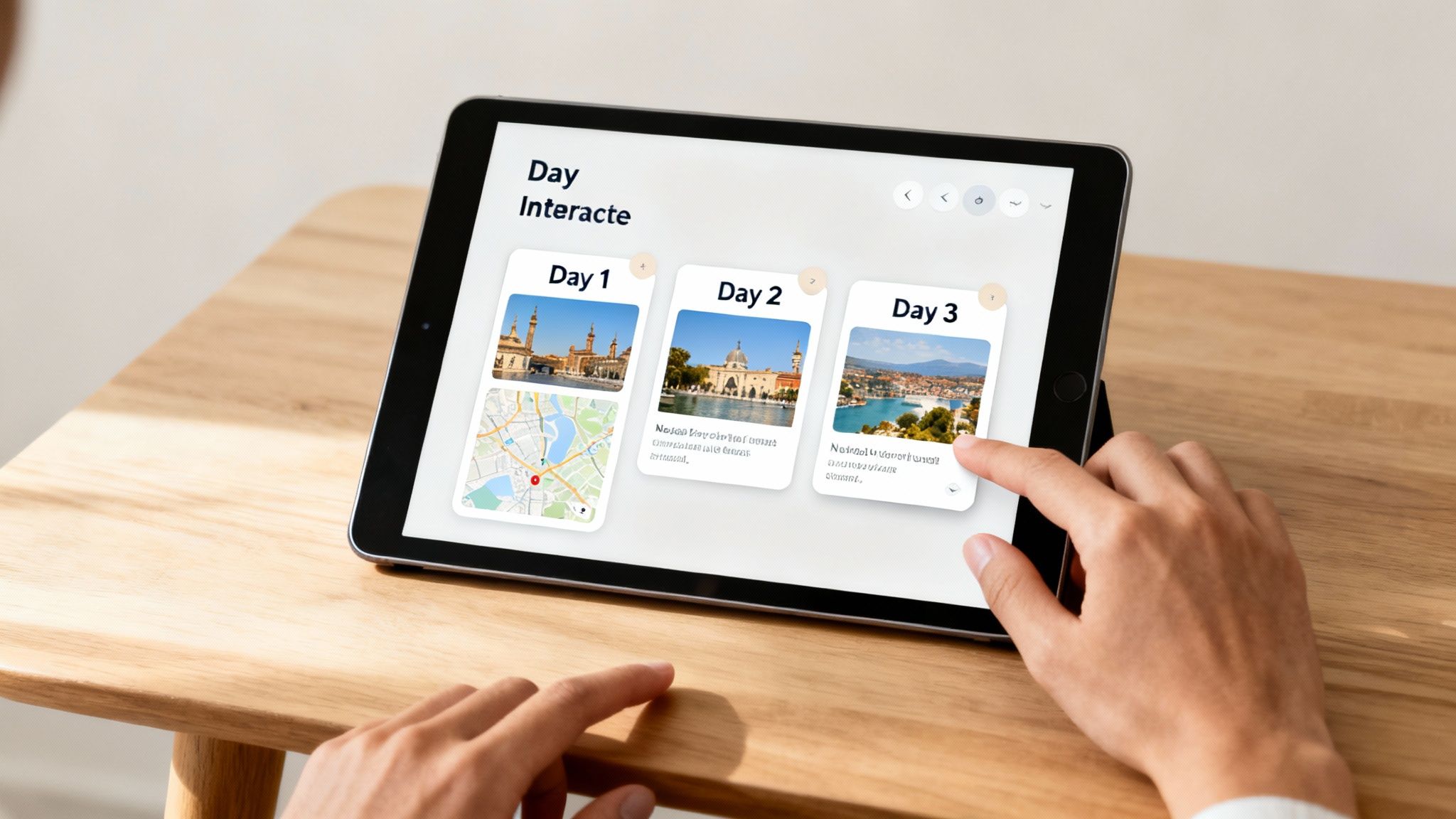
Start by looking for clusters. Which of your saved spots are huddled together in the same neighborhood? Using a simple drag-and-drop tool, you can pull these nearby locations into a single day's plan. This simple action prevents the classic travel mistake of zigzagging across a city, which absolutely drains your time and energy.
Imagine you have three pins in a historic old town, another two in a modern art district, and one on a scenic hill overlooking the city. You can structure your days like this:
- Day 1: The Historic Heart. Group the three pins in the old town. This becomes your dedicated day for wandering down cobblestone streets, admiring ancient architecture, and hitting up local markets.
- Day 2: Arts and Culture. Combine the two spots in the art district. Spend the morning at a gallery and the afternoon exploring trendy cafes and boutiques nearby.
- Day 3: The Grand View. Dedicate the morning to that scenic viewpoint, maybe planning a relaxed brunch somewhere with a killer view.
This grouping method is the foundation of a stress-free itinerary. It gives your days a natural rhythm and geographical logic.
A Real-World Example: A 3-Day Sarajevo Plan
Let's put this into practice with a 3-day plan for Sarajevo, a city overflowing with history and incredible food. After saving about 15 spots, I noticed they fell into three pretty clear themes.
Day 1: Baščaršija (Old Town) Immersion. I grouped all my pins within the historic Ottoman-era market. This included the Sebilj Fountain, Gazi Husrev-beg Mosque, and a few traditional ćevabdžinica spots for lunch. The entire day was walkable, filled with culture, and I spent less than $20 on food.
Day 2: War History and Remembrance. This day was for more somber, reflective sites. I grouped the War Childhood Museum, the Tunnel of Hope, and Galerija 11/07/95. These locations are more spread out, so planning them together helped me arrange for a single taxi to cover the whole day.
Day 3: Hills, Views, and Coffee Culture. The final day was all about seeing the city from above. I grouped the Yellow Fortress for sunset views with a few cozy cafes I'd saved in the surrounding hillside neighborhoods. It was the perfect, relaxed end to the trip.
This approach balances the big-ticket landmarks with the hidden gems you find scrolling social media, creating a much more well-rounded experience.
The most effective itineraries are built around themes or neighborhoods. This approach creates a narrative for each day, making your travels feel more intentional and less like a checklist.
Leaning on AI to Fill the Gaps
Even the best-laid plans have gaps. Maybe you need a lunch spot, a cool bar for the evening, or just a quiet place to grab a coffee. This is where an AI travel assistant becomes your secret weapon. Instead of spending hours Googling, you can ask specific, contextual questions about the spots you've already saved.
Think of it as having a local expert on call, 24/7. Here are some prompts you could actually use:
- "What's a great local lunch spot near the War Childhood Museum for under $20?"
- "I'm visiting the Yellow Fortress for sunset. What's the best way to get there from the city center?"
- "Is the Baščaršija market better on a weekday morning or a Saturday afternoon?"
- "Suggest a quiet cafe with Wi-Fi near my hotel for Day 2."
AI can instantly give you tailored recommendations that fit seamlessly into the plan you've already built. It’s how you add that local flavor and nail down the practical details without the research headache. You can explore how an AI itinerary generator can help automate some of these steps.
By combining your curated list of must-sees with smart AI suggestions, you build a plan that is efficient, personal, and perfectly suited to your travel style.
A good plan is one thing, but an optimized one? That’s where you save precious time, money, and energy on the road. Once you’ve grouped your saved spots into a rough day-by-day itinerary, it’s time to level up. This is where smart AI tools come in, helping you travel smarter, not harder.
The best way to plan a trip isn’t just deciding what to do, but fine-tuning how and when you do it. It’s about looking at your daily list and finding the most logical, time-saving sequence for everything.
Unlocking Hyper-Efficient Route Optimization
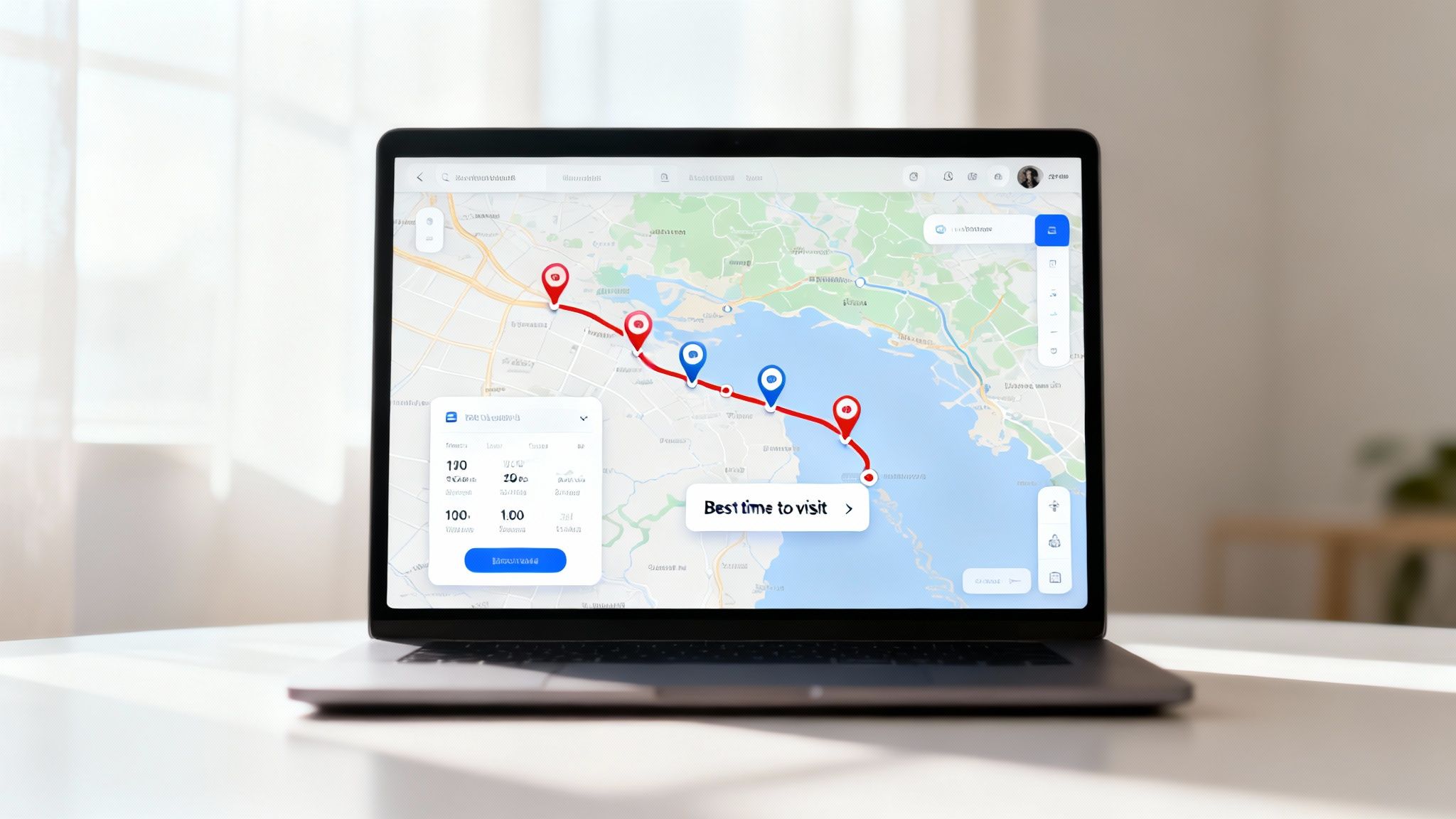
Have you ever spent an extra hour on the subway only to realize you passed your next destination on the way to the first one? It's a classic travel mistake, and one that AI-powered route optimization completely solves.
Instead of just guessing the best order for your stops, an AI assistant can instantly analyze your daily list and reorder it to create the most efficient path. This simple tweak can easily give you back an extra hour or two each day—time better spent lingering at a museum, discovering a new neighborhood, or just relaxing at a café.
This is an absolute game-changer for trips with packed schedules. Imagine you have six spots to visit in a single day in a sprawling city like Tokyo. An AI can instantly calculate the fastest route, factoring in public transit schedules and walking times, turning a potentially stressful day into a smooth adventure.
Using AI for Timing and Budgeting
Beyond just the route, smart tools can offer some seriously deep insights into timing and costs—two of the most critical parts of any successful trip. With travel trends constantly shifting, these features are more important than ever.
Recent data shows trip lengths are stretching, with averages expected to be 5.9 days in 2025 compared to 5.1 in 2024. With budgets getting tighter, more travelers are driving instead of flying, and remote workers are 39% more likely to take longer trips. AI tools that help figure out the 'Best Time to Visit' can be crucial for navigating these trends and getting the most out of your time and money. For more insights, check out the 2025 travel trends on TravelAge West.
Here are a couple of practical AI-powered features you can use right now:
- Best Time to Visit Predictor: This tool crunches historical data and crowd patterns to suggest the ideal time of day to visit a specific attraction. Want to see the Colosseum without the massive queues? An AI can tell you to go late in the afternoon on a Tuesday.
- Trip Cost Calculator: Get a realistic budget estimate based on your destination, travel style, and the spots you've saved. It can break down expected costs for food, transport, and activities, so there are no nasty surprises.
Using AI isn't about letting a robot plan your trip. It's about using data to enhance your own decisions, giving you the confidence that your plan is not only fun but also efficient and affordable.
A Personal Scenario Planning a Multi-City Trip
I recently planned a multi-city trip through the Balkans, and AI was my secret weapon. I had a long list of saved spots across Sarajevo, Belgrade, and Kotor but was totally stuck on how to allocate my time. I had 10 days and a fixed budget.
Instead of just winging it, I used an AI assistant to analyze my saved places for each city. I literally asked it, "Based on these saved spots and an average of $60 per day for activities and food, what is the ideal number of days to spend in each city?"
The AI analyzed the density and type of my saved locations and came back with a suggestion: four days in Sarajevo to cover the historical sites, three days in Belgrade for its vibrant city life, and three days in Kotor for a more relaxed pace. This simple query prevented me from over-booking my time in one place and feeling rushed in another. It was the perfect balance, ensuring I could fully enjoy each destination without blowing my budget. You can learn more about how to plan a trip with AI in our detailed guide.
This is the power of optimization. It transforms a good plan into a great one by taking the guesswork out of logistics, freeing you up to focus on the pure joy of discovery.
Travel Planning Methods Comparison
To see the difference, let's compare the old way of planning with a modern, AI-assisted approach. The contrast highlights just how much time and effort you can save.
| Feature | Traditional Method (Spreadsheets, Notes) | AI-Powered Planner (Dream Trip) |
|---|---|---|
| Route Optimization | Manual process of mapping points, guessing travel times. Prone to errors and backtracking. | Automatic, instant reordering of stops for the most efficient path, saving hours of travel time. |
| Timing Suggestions | Relies on generic blog post advice ("go early") or pure guesswork about crowd levels. | Data-driven recommendations for the 'Best Time to Visit' based on historical crowd patterns. |
| Budgeting | Manual research and spreadsheet formulas. Often misses hidden costs and is hard to update on the fly. | Automated cost estimates based on your saved places, travel style, and real-time local data. |
| Collaboration | Sharing links and documents via email or chat. Quickly becomes messy and disorganized. | A single, shared trip board where everyone can add places, vote on activities, and see updates instantly. |
| Adaptability | Rigid. Changing one part of the plan requires manually recalculating everything that follows. | Flexible and dynamic. Add a new spot, and the AI can instantly re-optimize the entire day's schedule. |
As the table shows, while traditional methods get the job done, an AI-powered planner automates the most tedious parts of trip planning. This shift allows you to spend less time on logistics and more time dreaming about the actual experience.
Finalizing Logistics and Sharing Your Trip Plan
With your itinerary optimized and looking sharp, it’s time to make it real. This is the exciting part where you lock everything in—booking flights, securing hotels, and figuring out what the heck to pack. It's also when you bring your travel buddies into the fold so everyone's on the same page.
Nailing down the logistics is what turns travel stress into pure anticipation. It’s not just about clicking "confirm"; it's about making smart moves that protect your budget and your sanity before you even leave home.
Nailing Down Bookings and Pre-Travel Essentials
This is where your budget meets reality. Flights and hotels are usually the biggest cash drain, so getting them right is a huge win. Beyond just hunting for deals, knowing the cheapest ways to book a hotel can seriously stretch your travel funds during this final push.
Once the big tickets are booked, a quick pre-travel checklist helps you avoid that last-minute "did I forget something?" panic. This isn't about creating more work; it's about making your departure day smooth and stress-free.
Your Pre-Travel Punch List:
- Book the Big Stuff: Lock in your flights and main accommodations first. Their prices jump around the most.
- Handle Key Transport: Book any long-haul trains or rental cars that connect the dots in your itinerary.
- Do a Doc Check: Is your passport valid for at least six months past your return date? It's a real requirement for many countries. Apply for any necessary visas now, not later.
- Alert Your Bank: Give your bank a heads-up about your travel dates. A frozen credit card in a foreign country is a vibe killer.
- Pack with Purpose: Ditch the generic packing list. Base what you bring on your actual itinerary. If Day 2 is a mountain hike, you need the right shoes. If Day 4 is that fancy dinner you booked, you’ll want the right outfit.
The Art of Collaborative Trip Planning
Group travel can be incredible, but it can also be a logistical train wreck. The difference almost always boils down to one thing: organization. Nothing kills the excitement faster than an endless group chat filled with conflicting flight details and lost links.
A shared, centralized plan completely changes the game. Instead of ten different screenshots of booking confirmations, everyone has access to a single, live itinerary.
The secret to a happy group trip? A single source of truth. When everyone can see the same map, schedule, and notes in real-time, the chaos just melts away.
Think about it: your friend lands a day early. With the shared plan, they can pull up the hotel address, see the check-in details, and find that cool lunch spot you saved nearby—all without a single "hey, what's the address again?" text. It keeps everyone in sync and feeling independent.
Turning Your Plan Into Shareable Content
For travel creators, that beautifully organized itinerary is more than just a personal plan—it’s gold. You can easily repurpose it into a shareable guide for your audience, turning your hard work into something that helps others.
This simple step transforms your personal planning into a valuable resource, giving your content a practical edge that people love.
How to Repurpose Your Itinerary for Your Audience:
- Polish Your Notes: Go through your saved spots and turn your personal reminders into helpful tips. "Meet Sarah at 7" becomes "Book a table in advance, this place gets packed on weekends."
- Add Real-World Context: Sprinkle in useful details. Think costs ("Dinner for two was about $40 with drinks") or insider tips ("The entrance is hidden down a tiny alley, so keep your eyes peeled!").
- Share the Public Link: Generate a shareable link to your itinerary map. You can embed it in a blog post, add it to your link-in-bio, or post it directly for your followers.
Doing this lets your audience see not just where you went, but how you did it. You're giving them a blueprint for their own adventure, which builds a much stronger connection than just posting pretty pictures.
Your Top Trip-Planning Questions, Answered
Even with the best tools in hand, a few questions always seem to pop up when you're laying the groundwork for a big trip. Getting those sorted is the key to planning with confidence. Let's tackle some of the most common ones.
When Is the Best Time to Actually Plan a Trip?
The honest answer? It depends. While last-minute deals can be a thrill, planning ahead almost always gets you better options and prices, not to mention peace of mind.
For a big international adventure, you’ll want to start looking at flights around 3-6 months out. If you’re staying closer to home for a domestic trip, a 1-3 month window is usually the sweet spot for finding that perfect balance of price and availability.
But peak season is a whole different ballgame. If you’re dreaming of a European summer or a major holiday getaway, you need to be thinking 6-9 months ahead. This gives you a real advantage in locking in decent rates for flights and sought-after hotels before they either sell out or the prices go through the roof.
The beauty of collecting inspiration year-round is that you're always one step ahead. When a flight deal pops up for a city you’ve already mapped out, you can pull the trigger without a second thought because the fun part of the research is already done.
What’s the Most Effective Way to Budget for a Trip?
A solid budget is what separates a stressful trip from a relaxing one. The easiest way to start is by breaking down your costs into five main buckets: flights, lodging, food, activities, and local transportation. It immediately shows you where the money is going.
For a quick reality check, use an AI-powered trip calculator to get cost estimates based on your destination and travel style. A trip to the Balkans, for example, is famously light on the wallet—a fantastic sit-down meal of grilled meats and šopska salata might only run you $15-20.
My go-to budgeting trick is to create two separate pots of money. The first is for all the big, pre-booked stuff like flights and tours. The second is a daily budget for everything else—food, metro tickets, coffees. And always, always add a 10-15% buffer for surprises.
This two-pronged approach keeps your daily spending on track while making sure the major expenses are handled long before you even pack your bags.
How Do I Plan a Group Trip Without All the Drama?
The secret to a successful group trip is simple: get everything in one place. Ditch the chaotic email threads and the novel-length group texts where important details go to die. A collaborative travel app is your new best friend.
Find a platform where everyone can toss their ideas onto a shared map and watch the itinerary come to life in real-time. When people can see the plan visually, it just clicks.
To keep things running smoothly:
- Assign a Captain for Each Area: Put one person on restaurant research, another on finding cool tours, and someone else on figuring out transport logistics.
- Agree on the Big Picture First: Before anyone spends a dime, make sure the whole group is on board with the main itinerary and the total budget.
- Keep it Visual: When everyone can see the daily schedule and pinned locations on a map, there’s just way less room for confusion.
This approach creates transparency and a sense of shared ownership, which is exactly what you need for a great group adventure.
Can AI Really Build a Better Itinerary Than Me?
Here’s how to think about it: AI isn’t replacing your personal taste; it's your expert logistician. You're still the creative director of your trip. The AI is just there to handle the tedious stuff. You provide the what—the amazing places you’ve discovered—and the AI figures out the how.
Let's say you've picked ten incredible spots you want to hit in a city. An AI tool can instantly map out the most efficient route between them, suggest the best time of day to visit each one based on crowd data, and even point out other cool things nearby you might have missed.
It’s not making the decisions for you. It’s making your decisions smarter with data. And that saves you a ton of time, money, and the mental gymnastics of trying to solve all those logistical puzzles yourself.
Ready to stop dreaming and start planning? Dream Trip turns your scattered social media saves into a perfectly organized, shareable itinerary. Build your first trip for free and see how easy it can be.

