

Let's be honest: the word "budget" doesn't exactly scream "epic vacation." For many of us, it brings up images of spreadsheets, cutting back, and saying no to fun. But what if I told you that a travel budget is actually the single most important tool for making your dream trip happen?
Treating your travel fund as a real financial goal—not just leftover cash—is the first step. This isn't about restriction. It’s about building a strategic plan that turns a vague idea like "a trip to Italy someday" into a booked flight and a packed suitcase.
Your Vacation Budget: A Tool for Freedom, Not Restriction
So many travelers think budgeting kills spontaneity. I've learned from years of planning trips that the exact opposite is true. A good budget is your financial roadmap. It gives you the clarity to spend money on the things that really matter to you, without worrying about every little purchase.
It's the difference between wishful thinking and intentional planning. Without a budget, you’re basically flying blind, making it way too easy to overspend and come home to a mountain of credit card debt. With one, you're in control.
The New Era of Intentional Travel Planning
The days of travel being a spontaneous, last-minute splurge are fading fast. People are now treating their vacations as a serious, year-round financial priority. One recent survey blew my mind: 92% of Americans plan to travel, and a whopping 79% are actively budgeting for it as a specific line item.
The average annual travel budget has even hit $10,244, which shows just how seriously people are taking their travel goals. You can read more about these travel budgeting trends if you're curious.
This new mindset lets you:
- Prioritize Experiences Over Expenses: A budget helps you see where you can cut back on forgettable costs to free up money for that once-in-a-lifetime cooking class in Tuscany or a guided trek in Patagonia.
- Travel Without Financial Guilt: When you know you've saved and planned for every expense, you can actually relax. You're free to immerse yourself in the moment without that nagging voice in your head asking, "Can I really afford this?"
- Make Your Dream Trip a Reality: A budget takes a fuzzy dream—like "I'd love to see Japan someday"—and turns it into an actionable plan with a clear finish line.
A budget doesn't tell you what you can't afford. It shows you what you can achieve with thoughtful planning. It’s about traveling smarter, not just cheaper.
Ultimately, figuring out how to budget for a vacation is the first real step toward taking control of your travel dreams. It’s a powerful tool that unlocks destinations you thought were out of reach and makes sure your hard-earned money goes toward creating memories that will last a lifetime.
Define Your Trip Before You Define Your Budget
Before you even think about a spreadsheet, you need a vision. Trying to budget for a vacation without knowing where you're going or how you like to travel is like packing a suitcase in the dark—you'll end up with all the wrong stuff and waste a ton of money.
Seriously, the decisions you make right now will have the biggest impact on your total trip cost. A 10-day solo backpacking trip through Vietnam is a completely different financial universe than a 7-day all-inclusive family getaway to the Caribbean.
Nailing this blueprint from the get-go makes every other step of budgeting a thousand times easier.
Pinpoint Your Travel Style
First, a moment of honesty: what kind of traveler are you? There’s no right answer here, but if your budget doesn't match your actual comfort level, you're setting yourself up for a miserable time. You'll either overspend trying to escape a hostel you hate or feel restricted when all you wanted was to relax.
Most of us fall into one of three buckets:
- The Savvy Backpacker: You're all about the experience, not the thread count. You’re perfectly happy in hostels, eating incredible street food, and navigating local buses to make every dollar stretch. Daily Budget Goal: $50 - $70.
- The Mid-Range Explorer: You're looking for that sweet spot between comfort and smart spending. Think boutique hotels, a mix of local eats and a few sit-down dinners, and maybe splurging on a guided tour for that one can't-miss landmark. Daily Budget Goal: $150 - $250.
- The Luxury Seeker: The goal is pure relaxation and premium service. You’re looking for upscale hotels with all the amenities, fine dining, and private drivers. Convenience and comfort are the top priorities. Daily Budget Goal: $400+.
Select a Destination That Fits Your Finances
Let's be real: not all destinations are created equal, financially speaking. A week in Switzerland will vaporize your savings in a way a week in Southeast Asia simply won't.
- Budget-Friendly Hotspots: Southeast Asia (Thailand, Vietnam), Eastern Europe (Hungary, Portugal), and parts of Latin America (Mexico, Colombia) are famously kind to your wallet. You can often live well on less than $70 a day.
- Mid-Range Meccas: Southern Europe (Spain, Italy, Greece) and many major U.S. cities fall here. You get amazing experiences, but costs for food and lodging are more moderate.
- Premium Pricetags: Scandinavia (Norway, Iceland), Japan, Australia, and many exclusive island destinations demand a bigger financial commitment for everything from your bed to your breakfast.
Think of your destination as the foundation of your budget. Choosing a location that naturally aligns with your spending goals is the easiest way to avoid financial stress later on.
Determine Your Ideal Trip Length
How long you travel is another huge piece of the budget puzzle. It might seem counterintuitive, but sometimes a longer trip has a lower cost per day. Your biggest single expense—usually the flight—gets spread out over more days.
A quick, 4-day city break can feel expensive on a daily basis because that flight cost makes up a huge chunk of your total spending. But a 14-day trip often has a much lower daily average, giving you time to settle in and explore more deeply without feeling the pressure to cram everything in.
Think about what you're trying to achieve. Are you after a whirlwind getaway or a slow, immersive journey? Once you have a general idea, an AI itinerary generator can be a game-changer. It helps you map out a realistic timeline based on your destination and must-do activities, turning a vague idea into a concrete plan and showing you exactly how much time you'll really need.
Research Real Costs for Your Destination
Alright, you've got your dream trip sketched out. Now for the moment of truth: figuring out what it's actually going to cost. This is where your travel fantasy starts turning into a real, achievable plan. It’s about way more than just flights and hotels—it’s about digging into all the little expenses that can sneak up and wreck an otherwise perfect budget.
We're going to break it all down, piece by piece. Think of it less like a scary math problem and more like a checklist for your future adventure. Getting this right means no nasty surprises, just a clear savings goal to aim for.
The Big Three: Nailing Your Major Expenses
For almost any trip you take, the lion's share of your budget will go to three things: getting there, sleeping there, and eating there. Get these three estimates solid, and you're more than halfway home. The key is to stop guessing and start researching.
Transportation (Flights & Ground): Use tools like Google Flights to get a feel for prices, but don't just look at one day—track them for a few weeks to spot the trends. Remember, that initial price tag isn't the whole story. Budget for checked baggage fees, which can easily tack on $60-$120 to a round-trip flight. Pro Tip: Flying into a major hub like London or Amsterdam and then taking a budget airline to your final destination can sometimes be cheaper than a direct flight.
Accommodation: Your travel style is the biggest factor here. You could be looking at a $30 dorm bed in a Lisbon hostel or a charming mid-range hotel for $150 a night. For a seven-night trip, that’s a massive difference—$210 versus $1,050. Hop on sites like Booking.com and Hostelworld to see what real places cost for your actual dates.
Food: This is the ultimate budget wildcard. A good rule of thumb for a mid-range trip in a city like Rome is to plan for $70-$90 per person, per day. That covers a simple café breakfast, a casual lunch, and a nice dinner. In Bangkok, you can eat amazingly well for just $30 a day by sticking to street food and local eateries. Local Insight: Look for "menu del día" or lunch specials, which offer multi-course meals for a fraction of the dinner price.
This chart gives you a quick visual of how your spending style—backpacker, mid-range, or luxury—shapes the entire budget.
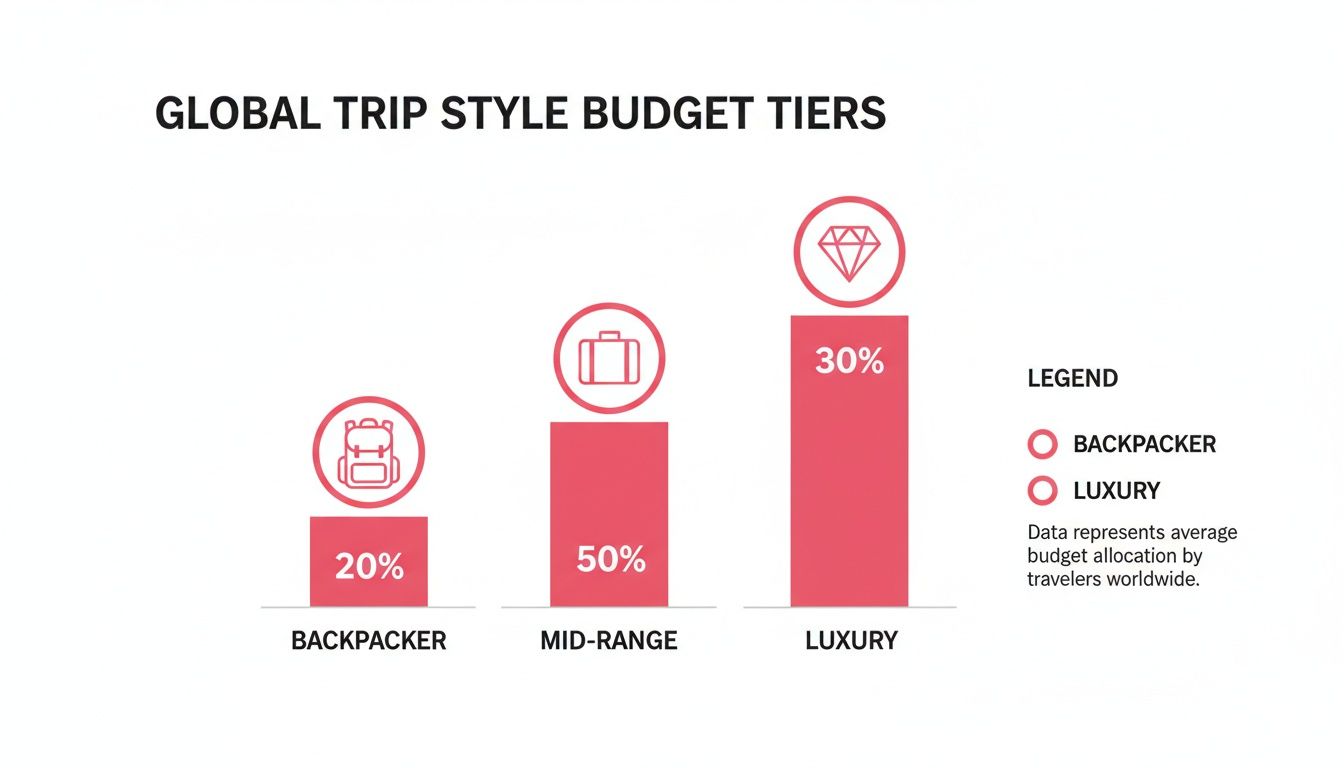
As you can see, most people land somewhere in the middle, finding that sweet spot between comfort and cost. Knowing where you fit is crucial for an accurate budget.
Sample Vacation Budget Breakdown for a 7-Day European City Trip (Per Person)
To make this more concrete, here's a sample worksheet. You can use this table as a template to build out your own budget, adjusting the numbers to fit your destination and travel style.
| Expense Category | Budget Traveler (€) | Mid-Range Traveler (€) | Luxury Traveler (€) | Notes & Estimation Tips |
|---|---|---|---|---|
| Flights | 200 - 400 | 400 - 700 | 700+ | Book 3-6 months in advance. Use price trackers. Factor in baggage fees. |
| Accommodation | 210 (30/night) | 700 (100/night) | 2,100 (300/night) | Hostels vs. boutique hotels vs. 5-star properties. Research real prices. |
| Food & Drink | 280 (40/day) | 490 (70/day) | 875 (125/day) | Mix supermarkets, street food, and restaurants to manage costs. |
| Activities & Tours | 75 | 200 | 500+ | Pre-book major attractions. Look for free museum days or city passes. |
| Local Transport | 40 | 70 | 150 | Use public transit passes. Budget for occasional taxis or ride-shares. |
| Travel Insurance | 30 | 60 | 120 | Based on 4-6% of total pre-paid, non-refundable trip costs. Don't skip this! |
| Misc. & Fees | 50 | 100 | 250 | Includes ATM fees, tips, pre-trip shopping, and souvenirs. |
| TOTAL (Estimate) | €885 | €2,020 | €4,820+ | This is a per-person estimate and will vary widely by city and season. |
This breakdown shows just how much the final number can change based on your choices. It’s not about spending the least, but spending intentionally on what matters to you.
Beyond the Basics: The Costs That Hide in Plain Sight
A good budget accounts for all the little things that separate a smooth trip from a stressful one. Overlooking these is a classic rookie mistake, and they add up fast.
Think about how you'll get around each day. Planning to use the metro in Paris? A 10-pack of tickets (a carnet) will run you about €17. Need a few Ubers after a late dinner? Budget $15-$20 for each ride.
And then there’s the fun stuff—the whole reason you're going! Look up the actual entrance fees for museums, parks, and tours. That ticket to the Louvre is €22. A guided tour of the Colosseum can set you back €50-€70. Make a list of your absolute "must-do" activities and find their real prices online.
Your budget shouldn't just get you to your destination; it needs to allow you to experience it. Forgetting to fund the fun is the fastest way to feel restricted on your own vacation.
Trying to keep all these numbers straight can be a headache. Using a dedicated trip cost calculator helps you itemize everything in one organized place, giving you a crystal-clear picture of your total estimated spend.
Don't Forget These Often-Missed Expenses
Finally, let's talk about the essentials that people often forget until the last second. These aren't optional—they need to be in your budget from day one.
Travel Insurance: Think of this as your financial safety net. A decent policy will cost between 4% to 10% of your total prepaid trip cost. So for a $3,000 trip, that’s around $120 to $300 for crucial protection against medical emergencies, cancellations, or lost bags.
Visa and Passport Fees: Does your destination require a visa? The fees can be anywhere from $20 to over $100. And if your passport is expiring, a U.S. renewal currently costs $130. Check all your documents and entry requirements months before you go.
Pre-Trip Purchases: You’ll probably need to buy a few things before you even pack your bags. This could be a new travel adapter ($20), a good guidebook ($25), or a pair of hiking boots for that mountain trek ($150). List out any necessary gear and add it to the budget.
Bank and Currency Fees: Let your bank know you're traveling, but also ask about their fees. Using a foreign ATM could cost $5 or more per withdrawal, and many credit cards charge a 3% foreign transaction fee on everything you buy. This can easily add another $50-$100 to your trip if you're not paying attention.
By digging into the details and accounting for every single one of these categories, you turn a vague wish into a concrete savings goal. It's a little bit of homework upfront, but this detailed estimate is the bedrock of a fantastic, stress-free trip.
Create a Realistic Savings Plan That Actually Works
With your total estimated cost in hand, it’s time to shift from dreaming to doing. Building a savings plan isn't about finding a huge lump sum of money overnight. It's about creating a consistent, automated engine that works for you in the background.
This is the moment your dream trip begins its journey from a number on a page to a stamp in your passport.
First things first, you need a clear target. A simple formula can transform a daunting total into a totally manageable monthly goal.
(Total Trip Cost - Current Savings) / Number of Months Until Departure = Your Monthly Savings Goal
Let's say your dream trip to Italy is estimated at $4,000. You’ve already got $500 stashed away, and you want to go in ten months. Your math looks like this: ($4,000 - $500) / 10 = $350 per month.
Suddenly, that big number feels a whole lot less intimidating, right?
Automate Your Savings and Pay Yourself First
The most effective way to save is to make it invisible. Relying on willpower alone is a recipe for failure; life gets busy, and it's far too easy to "forget" to transfer money. Instead, set up an automatic transfer from your checking account to a dedicated travel savings account.
Schedule this transfer to happen the day you get paid. This is the "pay yourself first" principle, and it's an absolute game-changer. By treating your vacation fund like any other essential bill, you prioritize your travel dreams before daily spending can whittle your paycheck away.
Consider opening a high-yield savings account (HYSA) just for your trip. These accounts typically offer much higher interest rates, meaning your money actually grows while it sits there. It also creates a psychological barrier, making you think twice before dipping into your travel fund for non-travel impulse buys.
Hunt Down and Eliminate Expense Leaks
Most of us have small, recurring expenses that drain our budgets way more than we realize. Finding these "expense leaks" is like discovering free money you can redirect straight into your vacation fund. It’s not about drastic deprivation; it's about mindful spending.
Start by auditing your last month's bank and credit card statements. Look for patterns and be brutally honest with yourself.
- Subscriptions: Are you paying for streaming services you barely watch or apps you never use? Canceling just two $15/month subscriptions frees up $360 a year—enough for a couple of nice dinners in Paris or a week's worth of scooter rentals in Thailand.
- The Daily Cafe Run: That $5 daily coffee habit adds up to $150 a month. You don't have to give it up entirely, but cutting back to twice a week and making coffee at home the other days can easily save you $90 per month.
- Lunch and Delivery Apps: Convenience comes at a high price. Packing your lunch three times a week instead of buying it could save you $40-$60 weekly. That’s over $2,000 in a year—a round-trip flight to Europe.
Redirecting this found money is the key. Every time you cancel a subscription or skip a purchased lunch, immediately transfer that exact amount into your dedicated travel savings account. This creates a powerful feedback loop, showing you how small, consistent actions directly build your travel fund, making the entire process feel rewarding.
Proven Strategies to Lower Your Travel Expenses
A solid savings plan is fantastic, but actively slashing your trip's final cost is where the real magic happens. Learning how to budget effectively means finding clever ways to spend less without actually cheaping out on your experience.
These tried-and-true strategies target the biggest budget killers—flights, lodging, and daily spending—so you can make your travel fund stretch further than you thought possible.
Master the Art of Booking Cheaper Flights
For most trips, your flight is the single biggest line item. Shaving even a couple hundred dollars off this one purchase can free up a huge amount of cash for amazing meals, unique activities, or even an extra night at your destination. Timing is everything.
- Embrace the Shoulder Season: This is the sweet spot right between the peak and off-peak seasons. Think Europe in May or September instead of July. You’ll almost always find lower airfare, thinner crowds, and perfectly pleasant weather. For the Caribbean, this means late spring after the winter rush but before hurricane season.
- Be Flexible with Your Dates: If you have any wiggle room, use a fare calendar tool like Google Flights to see prices across an entire month. Flying on a Tuesday or Wednesday is nearly always cheaper than a Friday or Sunday.
- Set Up Price Alerts: Don't just book the first flight you see. Use apps like Skyscanner or Hopper to set up alerts for your route. They’ll ping you when prices drop, letting you book at the perfect moment.
The global demand for travel is on a long-term upward trend, which means that early and smart planning is no longer just a good idea—it's a financial necessity.
Budgeting for a vacation now must account for a sustained rise in global leisure travel spending. For individual travelers, this means failing to pre-plan and lock in prices early can cost hundreds of dollars per trip as demand keeps climbing. Learn more about the future of global travel spending.
Choose Your Accommodation Wisely
Where you sleep can make or break your budget. The key is to match your lodging to your trip's goals and your personal travel style, because the right choice can save you hundreds.
Hotels: These are great for predictability, security, and amenities like daily housekeeping. They're often the best bet for shorter city breaks where a prime location is everything.
Vacation Rentals (e.g., Airbnb, Vrbo): Perfect for longer stays, families, or groups. Having a kitchen is a game-changer, letting you cook some meals yourself—one of the single biggest money-saving hacks for daily spending.
Boutique Hostels: Forget the old stereotypes. Modern hostels offer private rooms, stylish common areas, and social events. They are an incredible option for solo travelers or budget-conscious couples who still want a vibrant, central place to stay.
Slash Your Daily On-the-Ground Costs
Once you've arrived, your daily choices will determine whether you stick to your budget or blow past it. With a few insider tricks, you can live like a local and keep your wallet happy.
Eat Smart and Deliciously
Food is a huge part of the travel experience, but it doesn't have to be a massive expense. The number one rule? Skip the tourist-trap restaurants and eat where you see locals eating.
- Visit local markets for fresh produce and amazing ready-to-eat meals.
- Look for lunch specials or "menu del día" deals, which offer multi-course meals for a fixed, low price.
- Plan for one "splurge" meal, and stick to more affordable, authentic spots the rest of the time.
Navigate Like a Pro
Mastering public transportation isn't just a budget-friendly move; it’s a core part of immersing yourself in a new city.
- Buy multi-day transit passes instead of single-ride tickets.
- Use city bike-share programs for short distances—it’s cheap and a great way to see the sights.
- Plan your daily activities by neighborhood to minimize travel time and costs. A tool like Dream Trip’s route optimization can automatically group your saved spots together, saving you both time and transport money.
For even more ways to travel cheap, check out our other budget travel tips.
Harness the Power of Points and Rewards
Finally, don't overlook the value that might be sitting in your wallet right now. Strategically using credit card points and travel rewards can effectively erase some of your biggest expenses.
Many travel credit cards offer massive sign-up bonuses—often enough for a round-trip flight—and provide perks like free checked bags or travel insurance. If you already have a stash of points, research the best ways to redeem them through airline and hotel transfer partners to maximize their value. This one strategy can turn an expensive trip into a nearly free one.
Your Top Vacation Budget Questions, Answered
Even the most meticulously planned budget can leave you with a few lingering questions. That's perfectly normal. Let's tackle some of the most common uncertainties travelers face so you can finalize your plan with total confidence.
Think of this as ironing out the final details—the little things that make a big difference once you’re actually on the road.
How Much Should I Really Set Aside for Emergencies?
We’ve all heard the advice to have a contingency fund, but what does that actually mean? A solid benchmark is to add 10-15% of your total trip cost as a dedicated emergency fund.
For a $3,000 trip, that’s an extra $300-$450 you hope you never have to touch. This isn't for a last-minute splurge or a fancy dinner. It's your safety net for true, unexpected problems: a missed flight, a twisted ankle, or a stolen wallet.
Keep this cash separate from your daily spending money. I like to keep it in a separate savings account or even carry some crisp U.S. dollars hidden away. That way, you won't be tempted to dip into it for anything that isn't a genuine "uh-oh" moment.
What are the Best Tools for Tracking My Spending While I'm Actually Traveling?
The secret to not blowing your budget on vacation is a quick, daily check-in. It sounds tedious, but the right app makes it take less than two minutes a day.
- Traveling with Friends? Don't even think about using anything but Splitwise. It’s a lifesaver for group dinners, shared Ubers, and accommodations. It tracks who paid for what and settles up at the end, so nobody goes home feeling short-changed.
- Flying Solo or with a Partner? While a simple Google Sheet works, dedicated apps like TrabeePocket or Trail Wallet are built for this. They handle multiple currencies effortlessly and show you exactly where your money is going with handy charts.
The best tool is the one you'll actually use. Find one that feels simple and commit to a quick update each night before bed.
Staying on budget isn't about restricting your fun—it's about having the financial awareness to make smart choices. A quick daily check-in prevents small overspends from becoming a major problem by the end of your trip.
How Do I Budget for a Trip With a Crazy Exchange Rate?
Heading somewhere with a volatile currency can feel like a gamble, but you can definitely stack the odds in your favor. First, research the average exchange rate over the past year, then intentionally build your budget using a rate that's a little less favorable to you.
For instance, if the rate is usually 1 USD to 1.5 Local Currency, you might base your calculations on a rate of 1 to 1.4. This builds a natural buffer into every purchase.
Even better, lock in your biggest costs ahead of time. Pre-pay for your hotels and any major tours in your home currency before you even leave. This takes the biggest expenses off the table and protects them from any currency fluctuations. And of course, always use a credit card with no foreign transaction fees to get the best possible rate on the ground.
Is it Cheaper to Book a Package Deal or Do It All Myself?
Ah, the classic travel debate. The honest answer? It completely depends on your trip. Neither approach is always the cheaper option.
An all-inclusive package can be a fantastic deal for a resort-style vacation in a single location, like a week on the beach in Mexico. You get a predictable, fixed price for flights, lodging, and food, which makes budgeting incredibly simple.
On the other hand, if you're planning a multi-city trip through Europe or a backpacking adventure in Southeast Asia, a DIY approach is almost always cheaper and more flexible. Piecing it together yourself means you can eat at cheap local spots, use public transit, and find unique guesthouses—often saving a ton of money while getting a more authentic experience.
Ready to turn all this planning into a real adventure? Dream Trip is the AI travel planner that helps you save travel inspiration from social media and organize it into a perfect, actionable itinerary. Stop letting your dream trip ideas get lost in your camera roll.

