
If your phone is a digital graveyard of saved TikToks, Instagram Reels, and random Google Maps pins, you're not alone. This is what travel planning looks like now: a constant flood of incredible ideas with no clear way to turn them into an actual trip.
The old methods just don't cut it anymore. Spreadsheets and text-based lists can't keep up with today's visual, spontaneous style of planning. It's time to move past the endless scrolling and screenshotting. This guide will give you a real system for capturing, organizing, and building a functional travel plan from all that amazing content you've saved. You can dive deeper into this with our detailed article on how to plan trips from social media saves.
A Modern Approach to Travel Planning
Let's be honest, the game has completely changed. Planning a travel itinerary has evolved dramatically, especially with the rise of AI tools. A recent Portrait of American Travelers study found that a staggering 34% of travelers are now using AI to help plan their trips. This makes perfect sense when you consider Americans are planning to take an average of 4.2 vacations in the next 12 months, spending a record $5,138 per trip. You can check out more fascinating insights from MMGY's travel study on their site.
The goal isn't just to see more, but to experience more with less stress. A well-organized plan is your best tool for making that happen, transforming a chaotic list of ideas into a seamless journey.
This modern approach puts you in control without the usual headaches. Instead of manually looking up every single spot you've saved, you can use apps that automatically pull the location data and pin it directly onto your trip map.
Here’s why this new framework just works better:
- Centralized Inspiration: All your ideas—from any platform—live on one interactive map. This gives you a crystal-clear visual of your options.
- Reduced Overwhelm: By organizing as you save, you completely eliminate that daunting task of sifting through hundreds of screenshots or bookmarks later on.
- Efficient Scheduling: You can easily group nearby attractions, optimize your routes, and create a logical daily flow that saves precious time and energy.
Ultimately, this is about transforming that digital wanderlust into a well-organized, bookable adventure. It all starts with a simple framework that respects where your inspiration comes from and gives you the power to actually bring it to life.
Modern vs Traditional Itinerary Planning
The shift in how we plan is stark. The old ways were full of friction, while new tools are designed to remove it. Here’s a quick look at the difference.
| Planning Aspect | Traditional Method (The Hassle) | Modern Method (The Solution) |
|---|---|---|
| Inspiration | Scattered screenshots, bookmarks, notes | One-click saves from any app to a central hub |
| Organization | Manual data entry in spreadsheets or docs | Automatic location plotting on an interactive map |
| Visualization | Text-based lists, hard to see the big picture | A clear, visual map of all your potential spots |
| Collaboration | Endless back-and-forth emails and texts | Shared trip boards where everyone can contribute |
| Optimization | Guessing routes, manually checking distances | AI-powered route optimization for efficient days |
| Flexibility | Rigid plans, difficult to change on the fly | Easy drag-and-drop scheduling, adaptable plans |
As you can see, it's less about working harder and more about planning smarter. The right tools handle the tedious logistics so you can focus on the fun part: dreaming up the perfect trip.
Unify Your Travel Inspiration on a Single Map
This is where the magic happens. The real shift in planning a trip isn't in the endless collection of ideas—it's when you start organizing them. Instead of juggling saves across five different apps, a camera roll full of screenshots, and a bunch of pins on a generic map, you need to get everything in one place.
The goal is to centralize every single idea onto one interactive, trip-specific map. This one move transforms a chaotic mess of inspiration into a visual library you can actually use.
Think about it. You're scrolling through TikTok and see a video of a hidden rooftop bar in Lisbon with unbelievable sunset views. The old way? You screenshot it, telling yourself you'll look it up later. More often than not, that screenshot dies a lonely death in your photo gallery, forgotten forever.
Let's fix that.
From Social Media Saves to Mapped Realities
With the right tools, you can now use the "Share" button on platforms like Instagram or TikTok to send that cool spot directly to your travel planning app. The app instantly grabs the location data and drops a pin on your Lisbon map. Problem solved. No more screenshot graveyards.
This simple action builds a visual database of potential stops without any tedious manual work. Each saved spot is more than just a picture; it’s a data point on your map, complete with an address and details, ready for you to slot into your plan.
Why a Visual Map Is a Game Changer
Suddenly, you can see all your saved places—that bakery from a food blog, the vintage shop your friend recommended, and that scenic viewpoint from a Reel—all plotted on a single map. It gives you immediate clarity. You can instantly spot clusters of activity, helping you figure out the layout of a city and where you’ll probably want to spend most of your time.
A unified map doesn't just store your ideas; it reveals the shape of your future trip. It turns abstract "someday" spots into concrete possibilities, making the path from inspiration to a structured itinerary clear and intuitive.
This visual approach is especially powerful for DIY travelers. Recent data shows that over half of global tourists now arrange their own travel. This trend is led by Gen Z and millennials, who get over 50% of their travel inspiration from short-form video. Their use of AI for planning has also jumped 1.5x, which tells us they want tools that support this new, inspiration-first way of traveling. You can dig into more of these numbers in these global travel insights on tgmresearch.com.
This is the modern flow for turning social media daydreams into a real-world travel plan.
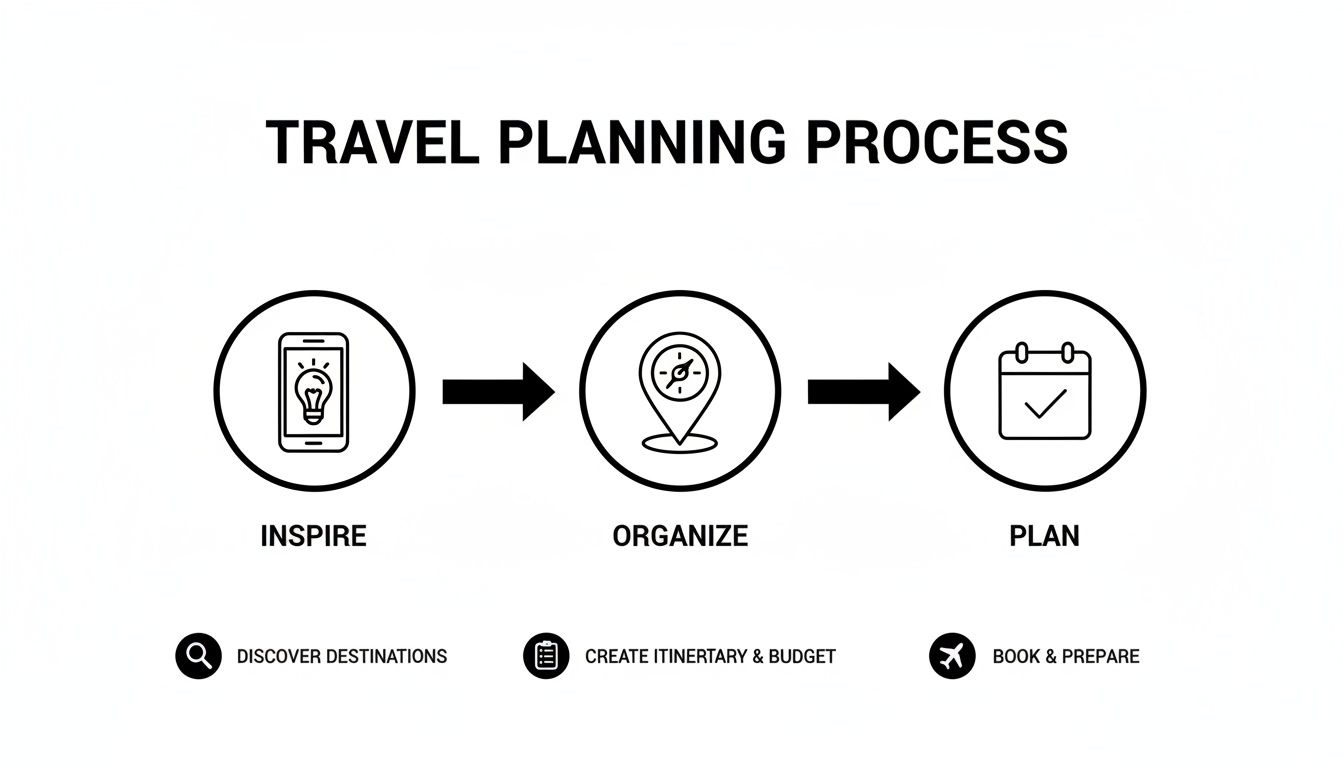
The big takeaway here is efficiency. Inspiration is captured and organized in one fluid step, removing all the friction that causes great ideas to get lost in the shuffle.
Start Building Your Idea Library
Right now, your goal isn't to build a final schedule. It’s to create a library of possibilities. Don't filter yourself. If something looks even remotely interesting, save it to your map. This brainstorming phase is what helps you learn how to plan a travel itinerary that’s actually built around what you want to do.
Start adding these kinds of places:
- Food and Drink: Cafes, restaurants, street food stalls, and bars you've seen online.
- Activities and Sights: Museums, parks, historical landmarks, and ticketed attractions.
- Photo Opportunities: Scenic overlooks, unique architecture, and cool street art.
- Shopping: Markets, boutiques, and specialty stores that caught your eye.
By organizing every potential stop on an interactive map, you're not just saving links; you're building the visual foundation of your adventure. This organized collection makes the next part—building a day-by-day plan—incredibly efficient and genuinely exciting. You're no longer staring at a blank slate, but at a map full of potential.
Build Your Daily Itinerary Visually
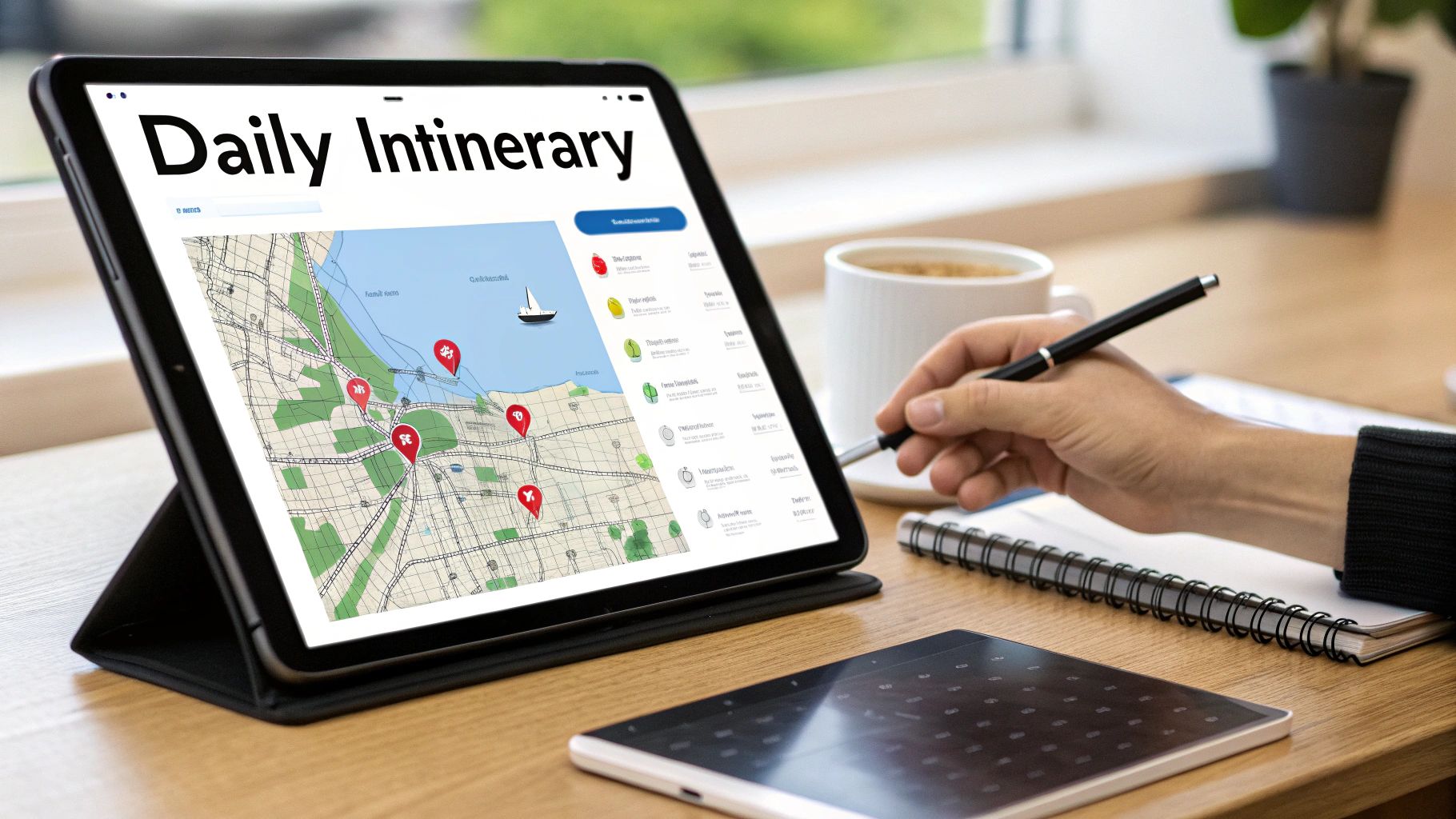
With all your saved spots beautifully arranged on a single map, you've moved past the chaos of scattered ideas. Now for the really fun part—seeing your trip start to take shape. This is where you graduate from a digital mood board to a functional, day-by-day schedule. The trick is to build it all visually, with the map as your guide.
Imagine you're planning a 3-day weekend in Chicago. Your map is dotted with pins for deep-dish pizza joints, the Art Institute, Millennium Park for that essential bean photo, and a few cool coffee shops you swiped from Instagram. Staring at that as a list is just overwhelming. But seeing it on a map? A path forward almost instantly reveals itself.
Group Activities by Neighborhood
The most logical first move is to group your pins by neighborhood. You’ll immediately notice how some spots are clustered together in the Loop, while others are way up north in Lincoln Park. This is your cue to create themed days based on geography to slash your travel time.
For that Chicago trip, it might look something like this:
- Day 1 The Loop: Dedicate this day to exploring Millennium Park, the Art Institute, and that nearby lunch spot you saved. You're walking between places, not sitting in traffic.
- Day 2 River North & Magnificent Mile: Group your architecture boat tour with a shopping stroll and a dinner reservation you made in the area. Everything flows together.
- Day 3 Lincoln Park: Plan to visit the zoo, walk along the lakefront, and finally hit that pizza place you pinned, all without crisscrossing the city.
This neighborhood-first approach is the foundation of a good plan. You’ll spend less time in transit and more time actually doing things.
Optimize Your Route with AI
Once you've assigned a handful of activities to each day, modern tools can take your planning from good to great. Instead of just guessing the best order to visit your spots, you can lean on AI-powered scheduling to optimize the route for you.
Just select the places for Day 1, and the tool will automatically arrange them in the most logical sequence. It calculates travel times between locations—whether you're walking or grabbing a train—ensuring you follow the most efficient path. This one little step can save you hours of backtracking and frustration. If you want to play around with this, an AI itinerary generator can build an optimized plan from your saved places and give you a fantastic head start.
The art of a great itinerary isn't about cramming in as much as possible. It's about creating a smooth, logical flow that feels effortless, giving you the mental space to be present and enjoy the moment.
This optimization also gives you a reality check. It might reveal that trying to visit five major attractions in one afternoon just isn't going to happen once you factor in travel and potential lines.
Find the Right Pace
One of the biggest mistakes travelers make is over-scheduling. A jam-packed itinerary can lead to burnout fast, turning a dream vacation into an exhausting race against the clock. The visual nature of map-based planning is your secret weapon for pacing your trip effectively.
When you see a single day stacked with five museum pins, it becomes obvious that you need to build in some breathing room. Here’s how to create a more balanced schedule:
- Anchor Your Day: Pick one or two "must-do" activities and treat them as your anchors. Everything else can be planned around them.
- Mix Major with Minor: Pair something high-energy and time-consuming (like a major museum) with something more relaxed (like a leisurely walk in a park or a long coffee break).
- Schedule Downtime: I mean this literally. Block out time in your schedule for "wandering" or "relaxing." This isn't wasted time; it's essential for recharging and leaves room for those spontaneous discoveries that often become the best memories.
For example, after spending three hours at the Art Institute of Chicago, your visual plan might show a 90-minute block for an unstructured walk toward your next pin. This flexible structure is the key to a trip that feels both productive and relaxing. By moving from a scattered list to a coherent, visually organized daily plan, you create an itinerary that works for you, not against you.
Refine Your Plan with Smart Tools and Data
Okay, you've mapped out your days and turned that messy collection of saved spots into a real, workable plan. That’s a huge step. But a truly great itinerary isn't just a list of things to do—it's a smart, almost predictive guide that smooths out the friction on the ground. This is where we fine-tune the logistics and layer in the data that turns a good plan into a brilliant one.
We're talking about everything from your budget to the best times to hit certain spots. Getting this right now means you can be more spontaneous later without accidentally blowing your budget or wasting half a day in a queue.
Nail Down Your Budget with a Cost Calculator
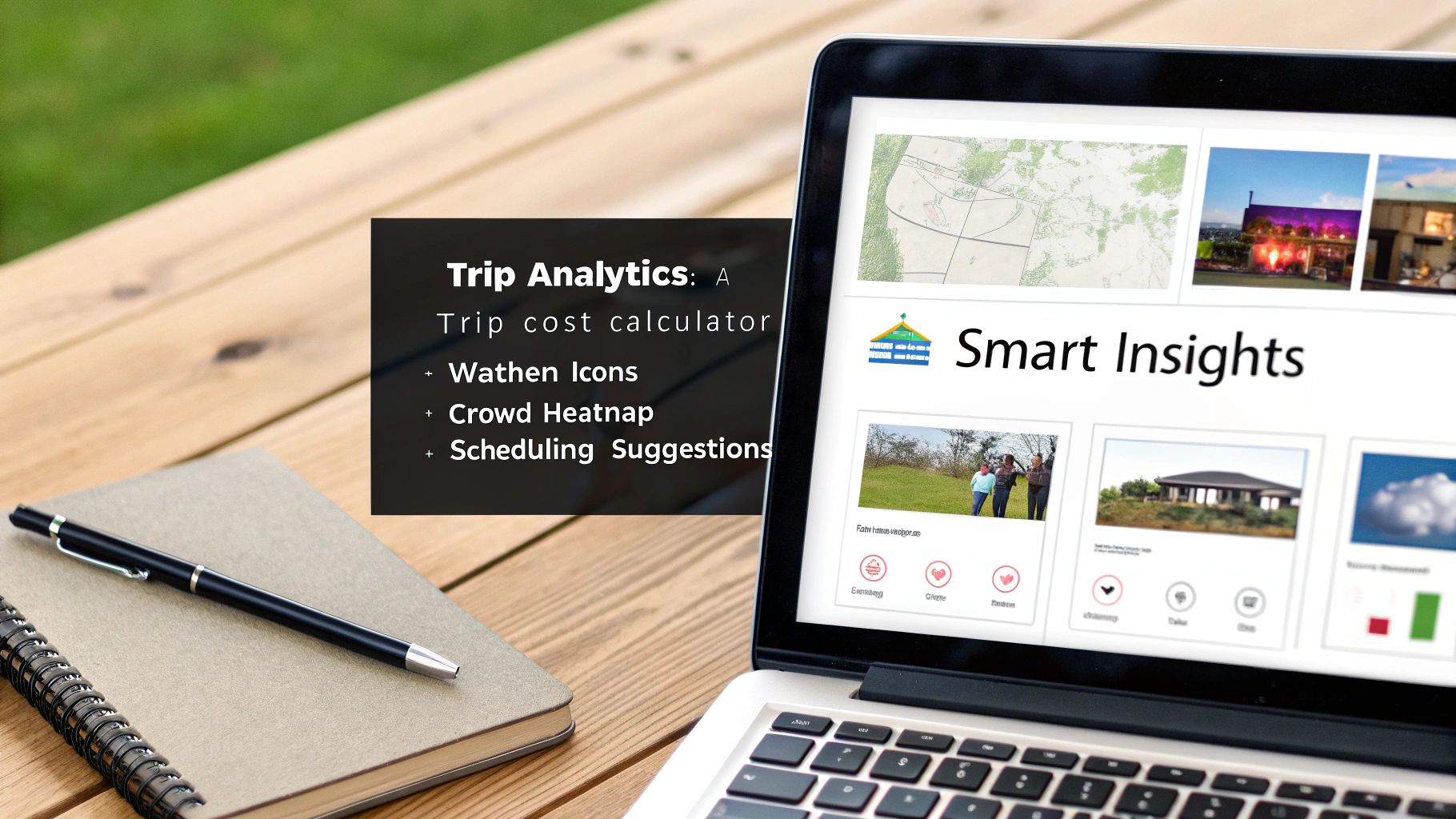
Before you book a single thing, you need a realistic grip on what this trip will actually cost. Guessing is a recipe for stressful surprises later. A data-driven approach, on the other hand, brings total clarity. The easiest way to do this is with a tool built for the job.
A solid trip cost calculator lets you plug in your destination and travel style to spit out a detailed budget. It goes way beyond just flights and hotels, accounting for all the little things that add up fast. For a firsthand look, you can play around with this free trip cost calculator and see how the numbers come together.
A good calculator will help you estimate:
- Transportation: Flights, rental cars, train tickets, and daily transit like subways or ride-shares.
- Accommodation: Nightly rates based on whether you're a hostel, hotel, or vacation rental person.
- Food and Drink: A daily average for everything from street food to a nice dinner out.
- Activities: Entry fees for museums, tours, and other ticketed attractions.
- Miscellaneous: A smart buffer for shopping, souvenirs, and those "just in case" moments.
This process gives you a real number to work with, helping you figure out where you want to splurge and where you can save.
An itinerary without a budget is just a wish list. Grounding your plans in financial reality is the most important step toward making your dream trip actually happen.
Determine the Best Time to Visit
Timing is everything. Go during peak season, and you might get perfect weather but also suffocating crowds and sky-high prices. The off-season can offer incredible deals, but you might be gambling with the weather. It's a critical balancing act, especially when 58% of travelers say they're worried about overtourism.
This is where smart planning tools can give you an edge by analyzing historical data. They’ll show you:
- Weather Patterns: Month-by-month breakdowns of temperature, rain, and sun.
- Crowd Levels: A good guess at how busy things will be, helping you dodge the worst of it.
- Pricing Trends: Typical costs for flights and hotels throughout the year.
For example, choosing Italy in May over July means you'll likely get beautiful weather, smaller crowds at the Colosseum, and much more affordable lodging. That single decision can dramatically improve the entire vibe of your trip.
Leverage an AI Assistant for Hyper-Specific Questions
Once the big pieces are in place, it's time to polish the small details. This is where an in-app AI assistant becomes your secret weapon. Instead of falling down a rabbit hole of a dozen different blogs, you can get instant, relevant answers about the exact places you've already saved to your itinerary.
Think of it as having a local expert in your pocket. You can ask the kind of super-specific questions that a generic Google search just can't handle.
Here are a few real-world examples:
- "What's the best vegetarian dish at that trattoria I saved in Rome?"
- "Is the Louvre less crowded on Wednesday afternoons in October?"
- "What's the fastest way to get from my saved hotel to the Eiffel Tower using public transit?"
- "Are there any good coffee shops near the art gallery I plan to visit on Day 2?"
This kind of detailed insight transforms your itinerary from a static document into an intelligent, interactive guide. You show up feeling confident, knowing you have the answers you need to make every moment count.
Adapt Your Planning for Any Trip Style
How you plan a trip should never be a one-size-fits-all deal. The strategy for a spontaneous weekend getaway is worlds apart from the one you'd use for a multi-week trek across another continent. The real secret to a plan that actually works is adapting your approach based on how long you're going, who you're with, and what you want to get out of it.
For a short trip—say, a romantic weekend in Paris—your goal is to squeeze the most out of every single moment. This is where a more detailed, structured itinerary becomes your best friend. Pre-booking museum tickets, locking in dinner reservations, and mapping out your daily walking routes are all critical. It’s all about efficiency, making sure you hit your high-priority spots without wasting precious time.
Now, flip the script to a longer adventure, like a two-week solo trip through Southeast Asia. Here, flexibility is your most valuable currency. Instead of a rigid, hour-by-hour schedule, you build a loose framework around key "anchor" points—a pre-booked flight between countries or a specific multi-day trek—and leave tons of room for spontaneous detours and discoveries.
Tailoring Your Itinerary for Short Trips
When you only have a few days, a tight, well-organized plan is non-negotiable. This is especially true now that last-minute travel is exploding. Short-term planning is booming, with one report showing a 20% quarter-over-quarter jump in searches for trips planned within a 0-13 day window. For international travel, that spike was even higher at 30%.
This trend, often sparked by a viral TikTok or a seasonal event, makes smart, tool-assisted planning more important than ever. To see more on this, check out the latest 2025 travel trends from Expedia Group.
For these quick escapes, your plan should be built around:
- Pre-Booked Anchors: Lock in tickets for the big stuff (like the Eiffel Tower or a hit Broadway show) to skip the soul-crushing lines.
- Optimized Daily Routes: Group your saved spots by neighborhood. This creates the most efficient walking or transit routes and saves you hours of backtracking across town.
- Confirmed Reservations: If you have a must-try restaurant on your list, get that dinner reservation locked in, especially on weekends when they fill up fast.
Think of it as crafting a "greatest hits" tour. You identify the absolute must-dos and build a logical schedule around them, leaving just enough wiggle room for a spontaneous coffee break or stumbling upon a charming side street.
Planning for Long-Term Travel and Flexibility
For trips lasting two weeks or more, your itinerary should feel more like a compass than a strict roadmap. The goal is to provide direction without killing the freedom to explore. Trust me, over-scheduling a long trip is the fastest way to burn out and miss the magic of unexpected opportunities.
For extended travel, the best itinerary is a flexible framework. It gives you structure and security for the big-ticket items while preserving the space for the spontaneous adventures that become the best stories.
Here’s how you build that framework:
- Set Your Tentpoles: First, identify the major non-negotiables of your trip. These are your "tentpoles"—things like flights between cities, a multi-day hike you have to book in advance, or a specific festival you refuse to miss.
- Create Regional Buckets: Instead of rigid daily plans, think in bigger chunks. For a month in Italy, you might break it down into "Week 1: Rome & The South," "Week 2: Florence & Tuscany," and so on. This gives you focus without being restrictive.
- Use Your Map for Spontaneity: Your map of saved spots now becomes your idea bank. Find yourself with a free afternoon in Florence? Just pull up your map, see what you’ve saved nearby, and go explore on a whim.
Collaborating on a Shared Itinerary
Planning a trip with your partner, family, or a group of friends adds a whole new layer of complexity. To avoid endless text chains and misunderstandings, a shared, collaborative tool is an absolute game-changer.
Start by creating a central map where everyone can drop their must-see places. From there, you can build out the daily schedule together, making sure everyone feels heard. This visual approach immediately highlights any logistical challenges—like when someone’s "must-do" is on the complete opposite side of the city. It lets you have a practical conversation about how to structure your days so everyone wins.
Once the plan is set, a shared digital itinerary means everyone has the latest version right on their phone. No more "Wait, I thought we were meeting at 10?" confusion.
Itinerary Planning Checklist for Different Trip Durations
To help you focus your efforts, here’s a quick breakdown of what to prioritize based on how long you'll be away.
| Planning Task | Weekend Getaway (1-3 Days) | Week-Long Vacation (5-10 Days) | Extended Travel (2+ Weeks) |
|---|---|---|---|
| Accommodations | Critical: Book entire stay in advance. | High Priority: Book first & last nights; flexible in between. | Flexible: Book first few nights only. |
| Transportation | Critical: Pre-book flights/trains & airport transfers. | High Priority: Book major flights/trains between cities. | Flexible: Book only major entry/exit flights. |
| Daily Activities | Detailed: Plan hour-by-hour; pre-book all tours/tickets. | Balanced: Plan 1-2 "anchor" activities per day. | Framework: Plan by region; leave most days open. |
| Dining | High Priority: Make reservations for key dinners. | Recommended: Reserve for special occasion meals. | Spontaneous: Discover places as you go. |
| Route Optimization | Critical: Group activities by neighborhood to save time. | Recommended: Plan efficient routes for "packed" days. | Not a Priority: Let the day's mood guide you. |
| Flexibility | Low: Stick to the plan to maximize time. | Medium: Build in buffer time for spontaneous finds. | High: The plan is just a suggestion. |
This checklist isn't about rigid rules but about shifting your mindset. For a short trip, you're a time-maximizer. For a long trip, you're an opportunity-seeker. Matching your planning style to your trip duration is the key to a stress-free and memorable adventure.
Common Questions About Travel Planning
Even the best-laid plans come with questions. Trip planning is a living process, and knowing how to handle a few common curveballs can be the difference between a stressful trip and a seamless one. We’ve rounded up some of the most frequent questions to give you quick, practical answers.
How Far in Advance Should I Plan My Trip?
This really boils down to your destination and travel style. If you're planning a big international trip to a hotspot like Italy or Japan during peak season, starting 3-6 months ahead is a smart move. This gives you the best shot at grabbing flights and top-rated hotels at reasonable prices before they sell out.
But let's be real, spontaneous trips are on the rise. We're seeing a 20-30% increase in last-minute bookings, with tons of people locking in plans just 0-13 days before they take off. This is especially true for domestic weekend trips inspired by a cool video you saw on social media.
The best strategy is often a hybrid one. Use a flexible app to start saving ideas months out, creating a loose framework for your trip. Then, you can dive in and lock down the day-by-day details closer to your departure date.
What's the Best Way to Organize a Group Itinerary?
Collaboration is everything for a group trip. Ditch the chaotic group chats and endless email chains—a shared visual plan is the only way to keep everyone sane and on the same page.
Start by creating a shared, interactive map where everyone can drop pins for their must-see spots and restaurants. This immediately helps everyone visualize the trip and see what's possible.
From there, follow these steps for a drama-free process:
- Use a Tool with Sharing Features: Pick a planner that lets everyone view, comment on, and add to the schedule. Transparency is your best friend here.
- Vote on Priorities: If the idea board is overflowing, have everyone vote for their top three priorities. This is a simple, democratic way to ensure the final plan has something for everyone.
- Let AI Optimize the Route: This is a lifesaver for groups. An optimized route means you’re not wasting an hour crisscrossing the city, which is a major source of friction when you're trying to coordinate multiple people.
- Share a Final Version: Once it's all locked in, share a final, read-only version of the itinerary. Now everyone has the same correct info right on their phone.
How Do I Balance a Plan with Spontaneity?
The most memorable trips always have a healthy mix of structure and freedom. Your itinerary should be a framework, not a rigid, minute-by-minute prison. The goal is to avoid over-planning while still having a guide to prevent that "what do we do now?" decision fatigue on the road.
This approach is sometimes called "tentpole planning," and it works wonders.
Plan two or three "anchor" activities per day—like a museum visit you pre-booked or a special dinner reservation. Then, leave the time in between intentionally open. This gives your day purpose while leaving room to discover a charming side street or linger at a cafe you stumble upon.
This is where your map of saved spots becomes your secret weapon. If you suddenly have a free hour, just pull up your map and see what cool places you’ve already vetted are just around the corner. It’s the perfect way to be spontaneous without feeling lost.
Can I Really Plan an Entire Trip Just on My Phone?
Absolutely. In fact, it's now the most efficient way to do it. Modern travel planning apps are designed for a mobile-first world, which makes sense—most of our travel inspiration comes from our phones anyway.
From a single device, you can now handle every single step of the planning process. You can save a location directly from the share menu on Instagram or TikTok, watch it pop up on your trip map, and then drag it into a daily schedule. You can ask an AI assistant for recommendations, calculate your budget, and share the final plan with your travel buddies.
This completely eliminates the need for clunky spreadsheets, printed confirmations, or juggling a dozen browser tabs. It makes on-the-go adjustments totally seamless, so you can focus on the experience itself.
Ready to stop dreaming and start planning? The Dream Trip app is the smartest way to turn your saved social media inspiration into a perfectly organized itinerary. Capture ideas from anywhere with one tap, build your plan visually on a map, and let our AI handle the route optimization.
Download Dream Trip on the App Store and start building your next adventure today!
Article created using Outrank


